

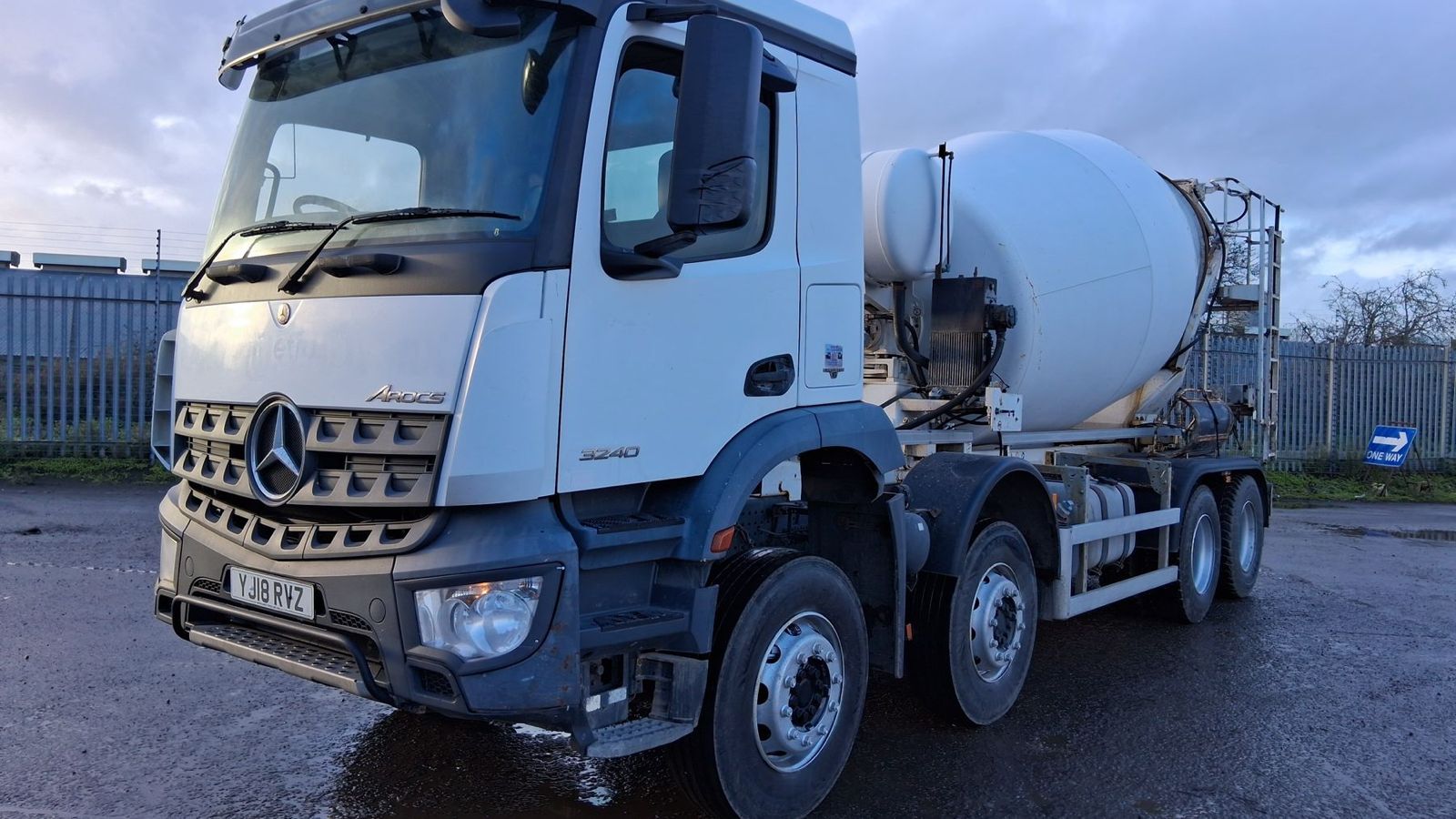
The concrete mixer truck and the concrete pump are two of the most specialist vehicles in UK construction. They’re expensive to buy, expensive to maintain, and when the time comes to sell, they need a buyer who understands what they’re looking at. Whether you’re selling a transit drum mixer, a volumetric batching unit, or a truck-mounted boom pump, this guide covers what your vehicle is worth in 2026, what affects the price, and how to sell without the usual complications.
What Is the Difference Between a Drum Mixer, a Volumetric Mixer, and a Concrete Pump?
Before getting into valuations, it’s worth being clear on the types of vehicle — because they have different buyer pools, different values, and different things that matter at resale.
Drum mixer (transit mixer)
The most common type of concrete truck. A rotating drum mounted on the back of a rigid chassis holds pre-batched concrete that was mixed at a batching plant before loading. The drum rotates continuously during transit to prevent the concrete from setting. The drum is emptied at the pour point, then cleaned and returned to the batching plant for the next load.
Typical specifications: 6–9 cubic metres drum capacity; 8×4 or 6×4 chassis; day cab only (most operators); water tank for drum cleaning. Common chassis: Mercedes Arocs, DAF CF, Scania G/P, Volvo FMX, MAN TGS.
Volumetric mixer (mobile batching unit)
A fundamentally different vehicle. Rather than carrying pre-mixed concrete, a volumetric mixer carries the raw ingredients — cement, aggregate, sand, and water — in separate compartments and mixes them on-demand at the pour point, to the exact specification and volume required. This eliminates wastage, allows specification changes between pours, and removes the time pressure of transit mixing.
Volumetric mixers are a specialist segment with a distinct buyer pool — primarily smaller ready-mix operations, specialist concrete suppliers, and self-lay operators. Common manufacturers: Hydramix, Cementech, On-Site Concrete, Baylynx. Common chassis: same 8×4 and 6×4 rigids as drum mixers, plus occasional 4×2 and 6×2 configurations.
Truck-mounted concrete pump (boom pump)
A completely different type of vehicle. A truck-mounted concrete pump carries a folded hydraulic boom arm and a concrete pumping unit; it receives concrete from a mixer truck and pumps it through the boom pipeline to the pour point — over obstacles, at height, or in locations a mixer truck can’t reach directly.
Boom pumps are measured by boom reach and output capacity (cubic metres per hour). Common manufacturers: Schwing Stetter, Putzmeister, CIFA, Sermac. Common chassis: Mercedes Actros/Arocs, Scania, Volvo FMX.
Concrete Mixer Drum Manufacturers — What’s Fitted and Why It Matters
When buying or selling a drum mixer truck, the drum brand is often as important as the chassis brand. The drum is the working element of the vehicle — it takes the wear, it’s the most expensive component to replace, and buyers in the ready-mix concrete sector have strong preferences about who made it. Here’s a breakdown of the main drum manufacturers found on UK trucks.
Schwing Stetter (Germany)
Schwing Stetter is widely regarded as the global benchmark for transit mixer drums, and in the UK market it’s the most sought-after drum brand on a used concrete truck. Stetter’s drums are built in high-grade 500-series steel with an integrated hydraulic drive system and oil cooler, and are offered in four distinct lines: BasicLine (standard), LightLine (weight-optimised for payload-sensitive operations), Heavy DutyLine (reinforced for the most demanding work), and TrailerLine (for trailer-mounted mixer configurations).
The Schwing Stetter range is fitted to chassis from over 15 manufacturers — on UK trucks you’ll most commonly find it paired with Mercedes Arocs, DAF CF, and Scania G/P. A truck with a Schwing Stetter drum commands a meaningful premium at resale over equivalent trucks fitted with lesser-known drum brands, because buyers know parts are readily available and the engineering is well understood.
Liebherr (Germany/Switzerland)
Liebherr is the other premium drum brand in the UK market, and on newer Mercedes Arocs trucks in particular it’s become the most commonly specified factory option. Liebherr’s mixer drum uses high-grade Hardox 450 wear-resistant steel and a distinctive spiral blade design optimised for complete discharge — reducing residual concrete in the drum and therefore wastage. The Liebherr HTM series (HTM 604, HTM 704, HTM 904 etc.) is the most widely seen in the UK fleet.
Buyers who understand the market treat Liebherr and Schwing Stetter as near-equivalent in quality and value — both command premiums over the mid-market alternatives, and a truck sold with documentation confirming the drum brand and model will consistently achieve a better price than one where the drum history is unknown.
McPhee (UK — Scotland)
McPhee is the most important UK-built drum manufacturer, based in Scotland, and has been supplying the British ready-mix concrete market for decades. McPhee drums are well-regarded for robust construction and straightforward maintenance, and — critically — the brand has strong support and parts availability across the UK without the lead times that can affect European brands.
McPhee is one of the most commonly specified drums on UK-market DAF CF, Scania P, and Renault trucks from UK bodybuilders. In the used market, a McPhee-drummed truck trades closely with Schwing Stetter equivalents and commands a clear premium over Hymix and lesser-known alternatives. McPhee also produces a range of drum capacities from 6m³ to 9m³ for different chassis configurations.
Hymix (UK)
Hymix is another UK-built drum manufacturer with a long history in the British ready-mix sector. Hymix drums are commonly found on older UK mixer trucks — particularly pre-2015 — and are a familiar name to operators who have worked in the UK concrete market for any length of time.
In the current used market, Hymix drums trade at a modest discount to Schwing Stetter and Liebherr, reflecting the brand’s slightly lower profile among buyers from outside the UK market and the reduced international parts network compared to the German manufacturers. For domestic UK buyers, Hymix is a well-understood and accepted drum brand.
Fruehauf (France/UK)
Fruehauf has historically been involved in UK mixer bodybuilding and their drums appear on a number of older UK fleet trucks. Fruehauf mixer drums are solidly built but have a smaller buyer following in the current market — partly because the brand is less active in new UK sales than it once was. Trucks with Fruehauf drums are typically valued at or slightly below equivalent Hymix-drummed machines.
CIFA (Italy)
CIFA — part of the Zoomlion group — is one of the largest concrete equipment manufacturers in the world and produces a range of transit mixer drums alongside its pump range. CIFA drums are more commonly seen on continental European trucks that have been imported into the UK than on originally UK-market vehicles. They’re well-engineered and parts are available, but buyer familiarity in the UK is lower than for the domestic and German brands, which is reflected in pricing.
Kel-Berg (Denmark/UK)
Kel-Berg, a Danish manufacturer with a UK base in Bicester, has been growing its share of the UK mixer market and supplies drum bodies to UK trucks alongside McPhee and Schwing Stetter as one of the mainstream options for new UK bodybuilds. Kel-Berg drums are built with modular assembly for quick parts replacement and use high-grade abrasion-resistant materials throughout. As Kel-Berg builds its UK presence, resale familiarity is increasing.
What Drum Brand Means for Your Sale Price
As a practical guide for sellers, the drum brand hierarchy in the UK used market looks approximately like this:
Top tier (strongest resale premium): Schwing Stetter, Liebherr
Strong mid-market: McPhee, Kel-Berg
Solid but modest premium: Hymix
Lower domestic premium (but still saleable): Fruehauf, CIFA, other imported brands
If you know what drum is fitted to your truck, state it clearly in any valuation request — it makes a real difference to the offer. If you’re unsure, the drum manufacturer’s name is typically stamped on a plate on the drum shell or hopper, and often on the hydraulic drive housing.
What Concrete Mixer Trucks and Pumps Do We Buy?
At Truck Trading we buy all types of concrete vehicle across the full range of makes and configurations:
Drum mixer trucks:
- Mercedes Arocs 3240 / 3242 8×4 — the most common new specification in the UK; Liebherr, Schwing Stetter, and McPhee drums widely fitted
- DAF CF 400 / CF 450 8×4 — widely used with McPhee and Fruehauf drum bodies
- Scania G410 / P380 8×4 and 6×4 — strong following in UK ready-mix operations
- Volvo FMX 460 8×4 — growing UK presence in concrete applications
- MAN TGS 35.360 / 35.400 8×4 — used widely in ready-mix and specialist concrete
Volumetric mixers:
- Hydramix, Cementech, On-Site Concrete, Baylynx, Utranazz volumetric bodies on DAF, Scania, Mercedes, and Renault chassis
Concrete pumps:
- Schwing Stetter S31 / S34 / S36 / S43 / S52 — the most common truck-mounted boom pump range in the UK
- Putzmeister M28 / M32 / M38 / M42 — another widely recognised UK pump brand
- CIFA K28 / K36 / K39 — Italian manufacturer with growing UK presence
- Sermac — French manufacturer; specialist and urban pump variants
What Is My Concrete Vehicle Worth in 2026?
Drum mixer trucks:
| Configuration | Year | Mileage | Approx. Value (ex VAT) |
|---|---|---|---|
| Mercedes Arocs 3240 8×4, Liebherr 8m³, Euro 6 | 2019–2021 | 150k–280k km | £45,000–£70,000 |
| Mercedes Arocs 3240 8×4, Schwing Stetter, Euro 6 | 2021–2023 | Under 150k km | £70,000–£100,000+ |
| DAF CF 450 8×4, McPhee drum, Euro 6 | 2018–2021 | 150k–300k km | £32,000–£52,000 |
| Scania G/P 8×4 drum mixer, Euro 6 | 2017–2020 | 200k–350k km | £28,000–£48,000 |
| Volvo FMX 460 8×4 drum mixer, Euro 6 | 2019–2022 | 150k–300k km | £38,000–£58,000 |
| MAN TGS 8×4 drum mixer, Euro 5/6 | 2016–2019 | 200k–350k km | £22,000–£38,000 |
| Older drum mixer (pre-2016, Euro 5) | — | High | £8,000–£22,000 |
Volumetric mixers:
| Configuration | Year | Approx. Value (ex VAT) |
|---|---|---|
| Volumetric mixer, modern chassis, Euro 6 | 2019–2022 | £35,000–£65,000 |
| Volumetric mixer, mid-age chassis, Euro 5/6 | 2015–2018 | £18,000–£35,000 |
| Older volumetric mixer (pre-2015) | — | £8,000–£18,000 |
Concrete pumps (truck-mounted boom):
| Configuration | Year | Boom Reach | Approx. Value (ex VAT) |
|---|---|---|---|
| Schwing Stetter S31 / S34 on Mercedes | 2016–2019 | 31–34m | £45,000–£75,000 |
| Schwing Stetter S43 / S52 on Mercedes/Scania | 2018–2021 | 43–52m | £80,000–£130,000 |
| Putzmeister M32 / M38 | 2016–2019 | 32–38m | £40,000–£70,000 |
| CIFA K36 / K39 | 2017–2020 | 36–39m | £38,000–£65,000 |
| Older pump (pre-2015, any brand) | — | Any | £15,000–£40,000 |
What Affects the Value of a Drum Mixer Truck?
Drum Make, Capacity, and Condition
The drum is the heart of the vehicle and the first thing any buyer assesses. Key factors:
- Drum manufacturer — Liebherr, Schwing Stetter, and McPhee are the most recognised and sought-after in the UK. Lesser-known or older drum brands carry a discount.
- Drum capacity — 7m³ and 8m³ are the most common UK specifications; 6m³ is smaller and narrows the buyer pool slightly; 9m³ is less common but valued by higher-volume operators
- Drum condition — internal wear (fins, blades), external shell integrity, and the condition of the charging hopper and chute assembly are all assessed. A drum with significant internal wear or cracked fins reduces value and may need replacement
- Water tank — the cleansing water tank (typically 300–500 litres) and washout system should be working; a damaged or non-functioning water system is factored into offers
- Discharge chute condition — wear on the main chute and extensions is expected but significant damage reduces value
Chassis Specification
Unlike a standard tipper, concrete mixer trucks run in cycles rather than long-distance routes — the mileage on the chassis often looks low relative to the truck’s age. However, the number of drum rotations and loading cycles is a better indicator of use, and buyers who understand this will look at both.
8×4 double-drive configurations with hub reduction axles are the most common and most sought-after for concrete work. Spring rear suspension is standard for the weight and terrain. Automatic gearboxes are increasingly common on newer mixer trucks and command a modest premium.
Euro Emission Standard
The same CAZ compliance considerations apply to concrete mixer trucks as to any HGV. Euro 6 trucks have the broadest domestic buyer pool; Euro 5 trucks face a narrowing domestic market but retain export demand.
What Affects the Value of a Volumetric Mixer?
Batching Unit Condition and Output
For a volumetric mixer, the batching unit itself — the conveyor systems, mixing auger, cement weigh system, water pump, and computerised batching controls — is where the value sits beyond the chassis. Buyers assess:
- Output capacity (m³ per hour) — higher output is valued by busier operators
- Condition of conveyors and auger — wear, damage, and calibration status
- Computer batching system — modern, user-friendly systems are preferred; older manual or outdated digital systems reduce value
- Aggregate and cement compartment integrity — any cracking or leakage is a red flag
- Calibration certificates — legally required for volumetric batching; buyers will ask
Output Records and Maintenance History
Volumetric mixers are typically tracked by output volume (m³ produced) as much as by mileage. A well-maintained unit with complete maintenance records and calibration history achieves meaningfully more than an equivalent machine with unknown provenance.
What Affects the Value of a Truck-Mounted Concrete Pump?
Pump Hours and Pressure Records
The pumping unit on a boom pump has its own operational hours, separate from the truck chassis hours. High pump hours, combined with high pumping pressure (typical for tall buildings or long horizontal runs), indicate significant wear on cylinders, pistons, and S-valves. Buyers will ask for pump hours and, where available, pressure logs.
Pump cylinder and S-valve replacement on a mid-size boom pump can run to £15,000–£30,000 — buyers factor this risk directly into offers.
Boom Reach and Condition
The boom is the primary value driver beyond the chassis and pump unit. Larger reach commands a premium because it allows more versatile deployment — taller buildings, greater horizontal distance from the pump. Boom condition (any damaged sections, weld repairs, hydraulic ram condition) is scrutinised carefully.
Wear Parts Status
Concrete pumps consume wear parts rapidly — delivery cylinders, pistons, S-valves, spectacle plates, and pipeline sections all wear with use. Buyers assess the remaining life on these components and price accordingly. Recent wear part replacement (documented) adds value; obviously worn or leaking components reduce it significantly.
How to Sell Your Concrete Vehicle
Option 1: Sell Directly to Truck Trading
We buy concrete mixer trucks (drum and volumetric) and truck-mounted concrete pumps across the UK — all makes, all conditions, all ages.
- Free quote within 24 hours — from specialists who understand this market
- Same-day payment — bank transfer on the day of collection
- Free UK-wide collection — we come to wherever the vehicle is
- No fees or commission — the price we quote is exactly what you receive
- All conditions considered — working, high mileage, high drum or pump hours, non-running
Get your free concrete truck quote →
Option 2: Auction
Concrete trucks do appear at commercial vehicle and specialist plant auctions. The niche nature of the buyer pool means auction pricing can be unpredictable — a specialist buyer on the right day can drive strong prices, but thin attendance at the wrong sale can result in a poor outcome.
Option 3: Private Sale
Commercial Motor, Auto Trader Trucks, and Truckpages all carry concrete mixer and pump listings. The buyer pool is specialist and smaller than for standard trucks, which means enquiries are often genuine but fewer in number. A well-presented vehicle with full drum or pump documentation can sell privately at a good price — but allow more time than for a standard tractor unit.
What Paperwork Do You Need?
- V5C logbook
- Current MOT certificate
- Drum service and maintenance records — including drum blade condition reports
- Volumetric calibration certificates — legally required for volumetric batching
- Pump hours log and pressure records — for boom pumps
- Finance settlement letter — if subject to HP or conditional sale
Get Your Free Quote Today
Get your free concrete truck or pump valuation →
📞 0161 432 1477 | 07540 694069
📍 Stockport, Greater Manchester — collecting UK-wide
Related Guides
- Sell My Tipper Truck — Complete UK Guide
- Sell My HIAB or Crane-Mounted Lorry
- Is Your Truck Worth More Than You Think? 2026 Valuation Guide
- How to Sell a Truck: A Complete Guide
Truck Trading — the safe way to sell your truck. Free valuations, same-day payment, free UK-wide collection.
📞 0161 432 1477 | trucktrading.co.uk | Stockport, Greater Manchester